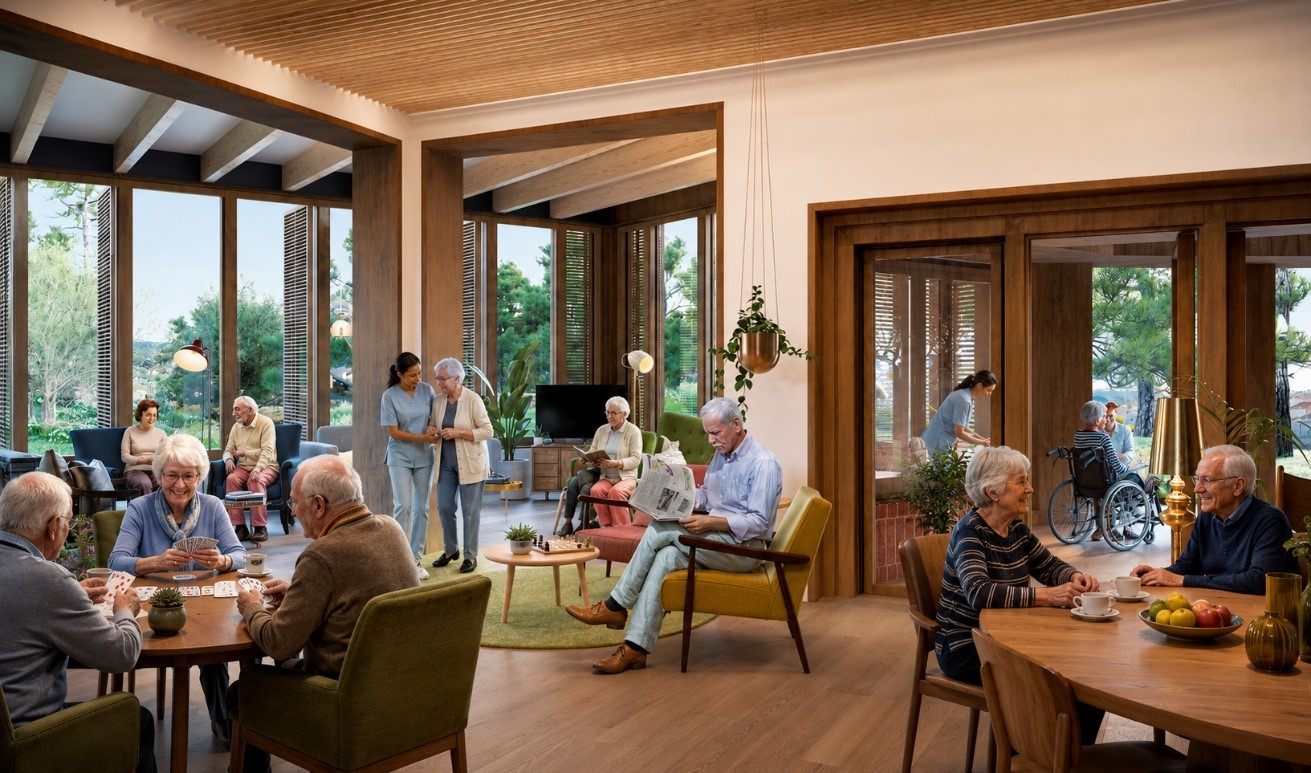
How we identified the highest and best use of a development land asset through a structured process that combined planning feasibility, market potential, and a market sounding exercise supported by a database of more than 450 operators and investors, ultimately prioritizing senior living as the value-maximizing use.
A family-owned development land asset of approximately 13,600 m², with close to 10,900 m² of buildable area, represented significant value creation potential. Located within a consolidated urban environment in a major metropolitan area, it also presented a critical strategic question. The ownership was not asking whether the land had potential, but which use could maximize its value.
The starting point was a highly attractive location. It was well connected, with schools, retail, and sports facilities within easy reach, while also benefiting from proximity to nature and a quiet residential environment. Yet the asset lacked a clear strategy regarding its future use. Planning regulations allowed for several possible development options; the challenge was determining which one genuinely made sense.
Any alternative had to comply with planning regulations and available development rights. It also had to satisfy a more demanding test: genuine market demand and investor appeal. Choosing incorrectly could commit the land to a use with weak demand fundamentals or uncertain financing prospects.
The strategic opportunity was to transform that optionality into an informed decision by selecting, among all feasible uses, the one that maximized asset value while remaining financeable. Instead of relying on intuition, assumptions were tested against the market itself. Ultimately, the aim was to create a decision-making tool rather than another report.
“Deciding what a piece of development land will become is the best investment that can be made in it.”

We structured the project as a funnel, moving from the universe of permissible uses to a validated recommendation. Each option passed through a series of filters before advancing to the next stage. The first screening focused on planning regulations and development capacity: eliminating uses that were not legally feasible and retaining only those genuinely viable for the land asset.
For this subset, we conducted a detailed market analysis of each candidate use, examining both supply and demand dynamics. For senior housing, we assessed existing supply through bed-per-capita ratios, quality, and market positioning. We compared this with demand segmented by age cohorts (65+ and 80+) across multiple catchment areas. This analysis revealed a structural and growing gap: a stagnant supply of senior accommodation facing an ageing population, with coverage ratios below industry benchmark levels.
The stakeholder universe was carefully assembled rather than improvised. We built a database of more than 450 operators and investors using leading sector sources, including the Catalan Association of Care Homes (ACAD), the Senior Housing and Healthcare Association (SHHA), the Associated Retirement Community Operators (ARCO), real estate industry institutions such as ULI, and specialized market intelligence reports. It was segmented by stakeholder type—operators and investors—and by geography, covering Spain, Europe, and the United States.
“Validation was not the final step of the study; it was the instrument that transformed a use hypothesis into an investment-grade decision.”
On this basis, we conducted a market sounding exercise supported by an asset teaser, targeted emails, calls, and interviews. Stakeholders included domestic and international senior housing operators, healthcare real estate funds and REITs, private equity and real estate investment managers, insurance companies, healthcare groups, listed real estate vehicles, residential developers, and family offices. Their diversity provided a representative response base, allowing us to evaluate the asset’s attractiveness from multiple market perspectives rather than through the lens of a single investor category.
Ultimately, the funnel converged on three finalist uses—senior housing, sports infrastructure, and clinical or healthcare facilities—which could be developed independently or in combination. Each was assessed using the same analytical framework: market fit, value creation potential, and demonstrated investor appetite.
The outcome was not a single definitive answer, but a prioritized recommendation. Among the three finalist uses, senior housing emerged as the preferred option for two converging reasons: stronger underlying demand, driven by the supply gap identified during the analysis, and greater investor interest expressed throughout the market sounding process.
Within the senior segment, the assignment refined a key positioning decision: care home or senior living. The former maintains a stronger healthcare component. In contrast, the latter is a more lifestyle-oriented model with greater focus on experience and quality of life. The location—peaceful and surrounded by nature—offered a particularly strong fit for senior-oriented uses, while the choice between these two models would ultimately define both the asset’s positioning and the profile of the operator to be attracted.
A second recommendation addressed implementation. Rather than developing the full 10,900 m² at once, we proposed an initial phase focused on the priority use. Complementary uses — sports and healthcare — could be incorporated in subsequent stages. This phased approach captures value progressively, aligns investment timing with market demand, and preserves optionality rather than committing the entire development land asset from the outset.
“A use decision is only robust if the market supports it before the first stone is laid. That is why we did not deliver an opinion, but a recommendation validated by the people who would ultimately invest.”
Beyond the recommendation, the process left the ownership with a lasting strategic asset. This included qualitative and quantitative market feedback, a shortlist of qualified stakeholders with genuine interest, a prioritized use strategy, and a replicable methodology for future land-use decisions.
Barcelona Office
Antoni Bell 2, 4th Floor – C
Sant Cugat del Vallès 08174
+34 93 280 7084
Madrid Office
Alfonso XII 62, 2nd Floor
Madrid 28014
+34 91 048 8455
To stay up to date on the latest trends and key information in our sectors, follow us


Accessibility Tools